
When you’re investing in kitchen cabinetry, the type of wood you choose is only half the story. How that wood is milled dramatically affects its appearance, structural stability, and long-term performance, especially in high-use spaces like kitchens. These cutting techniques can be used on oak, maple, cherry or walnut – any hard wood species.
Three primary cuts dominate high-end cabinetry: plain sawn, quarter sawn, and rift cut. Each offers its own aesthetic look, cost, structural benefits, and keep in mind that each cut will stain to a slightly different finish color. Here’s the difference between them.
PLAIN SAWN (Flat Sawn)
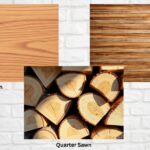
Plain sawn lumber is cut straight across the log, producing the most usable wood with the least waste. It’s the most common cut and often the most affordable. It’s best for warm, traditional, rustic, or cost-conscious designs.
What it looks like:
- Waves, arcs, and cathedral patterns in the grain
- More visual movement and variation
Advantages:
- Least expensive
- Readily available in wide boards
- Classic, familiar wood appearance
Considerations:
- Most prone to cupping and warping over time
- Greater seasonal expansion and contraction
If you love traditional hardwood grain or farmhouse-style character, plain sawn is a good choice.
QUARTER SAWN
Quarter sawn boards are produced by first cutting logs into quarters, then slicing them perpendicular to the growth rings. This produces straight grain with distinct flecking—especially in white oak. This is used for Craftsman, transitional, and high-end white oak cabinetry.
What it looks like:
- Straight grain lines with shimmering flecks
- Dimensional, elegant surface texture
Advantages:
- More stable than plain sawn
- Signature fleck pattern adds visual depth
- Resists warping and cupping
Considerations:
- Higher cost due to more waste and labor
- Boards may be narrower depending on log size
Quarter sawn white oak has become a centerpiece trend in luxury kitchens because it feels organic and refined.
RIFT CUT
Rift cut angles boards at approximately 45 degrees to the rings, creating the most uniform and linear grain of all three. This is best for modern, luxury, minimalist styling.
What it looks like:
- “Perfect” vertical grain
- Very clean, subtle, architectural appearance
- Very minimal flecking
Advantages:
- Most dimensionally stable
- Superior consistency across large installations
- Ideal for wide panels and clean lines
Considerations:
- Highest cost due to intensive milling and lower yield
- Less natural grain “character”
If your design goals include seamless grain-matching across doors, drawer fronts, and panels, rift sawn oak is unmatched.
Side-by-Side Summary
| Feature | Plain Sawn | Quarter Sawn | Rift Cut |
|---|---|---|---|
| Grain Appearance | Cathedral / wavy | Straight w/ ray fleck | Very straight, uniform |
| Cost | $ (least) | $$ | $$$ (most) |
| Stability | Fair | High | Highest |
| Visual Style | Rustic / traditional | Classic / dimensional | Modern / clean |
| Yield from Log | Most | Less | Least |
| Notable Trait | Economical | Flecking in oak | “Perfect” linear grain |
How to Choose
| Preferences | Best Options |
|---|---|
| Traditional / rustic | Plain Sawn |
| Classic, refined, textured | Quarter Sawn |
| Minimalist, ultra-modern | Rift Cut |
| Tightest grain consistency | Rift Cut |
| Best value | Plain Sawn |
| Unique ray fleck pattern | Quarter Sawn |
Which Cut Is Best for Your Cabinets?
While rift cut lumber may seem like the obvious choice based on performance and aesthetics, the best option depends on your design goals and surrounding finishes.
- Want the wood to stand out?
Plain sawn white oak or another species with a strong grain pattern can add movement and a focal point in minimalist spaces. - Want subtle, modern elegance?
Rift cut lumber keeps the look clean and consistent, especially when paired with bold tile, dramatic lighting, or layered finishes. - Want a balance of character and refinement?
Mixing quarter sawn and rift cut material is common in some custom cabinetry—sides and frames may use rift cut pieces for consistency, while doors or panels use quarter sawn for texture.
Ultimately, grain selection is just one part of cabinet design. Color, stain, door style, architectural details, and the overall palette should guide material choice.
Ready to Select the Perfect Wood for Your New Kitchen?
At U S Kitchens & Baths, we help homeowners, builders, and designers choose the right combination of cabinets, wood species, and finishes to bring their vision to life, whether they’re just refreshing a single room or designing a full custom kitchen.